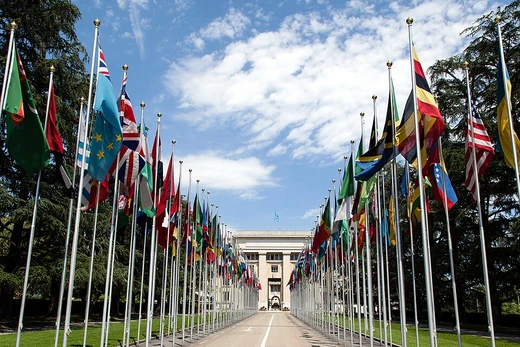
Globalization
Process of increasing global interdependence and integration.

Globalization describes how countries around the world have become more interconnected and dependent on one another, particularly in their economies, markets, societies, and cultures. This process has been driven by several developments: fewer barriers to international trade, freer movement of capital, better transportation networks, and leaps in information and communication technology. Though the word itself showed up in the early 1900s, it only became widely used in the 1990s, when people started talking about the heightened international links that followed the Cold War. The first major wave of modern globalization took off in the late 19th century (around 1870–1914), rapidly knitting together the world’s economies and cultures.
The roots of globalization go back to the 1700s and 1800s, a time when the Industrial Revolution sparked major improvements in how people traveled and communicated. These advances boosted global interactions, helping international trade grow and allowing ideas, beliefs, and cultures to spread more freely. Between 1990 and 2010, globalization sped up dramatically, thanks to the information and communication technology revolution—which made communication much cheaper—along with trade liberalization and the movement of manufacturing to emerging economies, especially China. Scholars typically break globalization into three main categories: economic, cultural, and political.
Supporters argue that globalization fuels economic growth and broader social progress. Critics, however, contend that it harms social well-being, pointing to issues like ethnocentrism, environmental damage, and other downsides.
**Etymology and usage**
The English word *globalization* first appeared in the 1930s, but only in educational contexts, and it didn’t catch on. Over the following decades, it popped up occasionally in academic and media circles, but without a clear definition. One early use that resembles today’s meaning came from French economist François Perroux in his early-1960s essays, where he used the similar French term *mondialisation* (translated as *mundialization*). Theodore Levitt is sometimes wrongly credited with inventing the term in the mid-1980s, though he did help popularize it and bring it to a mainstream business audience around that time.
In French, *globalization* and *mondialisation* are not exact synonyms. Ther
- first_known_usage
- 1930s
- popularized_in
- 1990s
- field
- Economics, Sociology, Political Science
- key_drivers
- Reduction of trade barriers, liberalization of capital movements, transportation infrastructure, information and communication technologies
- major_areas
- Economic globalization, cultural globalization, political globalization
Lore & Background
Sociologists Martin Albrow and Elizabeth King define globalization as 'all those processes by which the people of the world are incorporated into a single world society.' Anthony Giddens writes: 'Globalization can thus be defined as the intensification of worldwide social relations which link distant localities in such a way that local happenings are shaped by events occurring many miles away and vice versa.' Roland Robertson described globalization as 'the compression of the world and the intensification of the consciousness of the world as a whole.'
Reader's Guide
Globalization is a central concept in modern social science, describing the increasing interconnectedness of economies, cultures, and political systems across the world. Its significance lies in its profound impact on international trade, capital flows, migration, and the spread of ideas. Proponents point to economic growth and broader societal development as benefits, while opponents claim globalizing processes are detrimental to social well-being due to ethnocentrism, environmental consequences, and other potential drawbacks. The term's evolution from obscure academic usage in the 1930s to a widely debated concept in the 1990s reflects the dramatic changes in global connectivity after the Cold War. Academic literature commonly divides globalization into three major areas: economic, cultural, and political. The concept continues to inspire competing definitions and interpretations, with scholars like David Held emphasizing its dimensions of extensity, intensity, velocity, and impact. Manfred Steger identifies four empirical dimensions—economic, political, cultural, and ecological—plus an ideological dimension. Paul James distinguishes four forms: embodied globalization (movement of people), agency-extended globalization (circulation of agents), object-extended globalization (movement of commodities), and disembodied globalization (transmission of ideas and information). The legacy of globalization is contested, but its role in shaping contemporary society is undeniable.
Did You Know?
- The term globalization first appeared in the 1930s, but the first major wave of modern globalization is conventionally dated to the late 19th century (around 1870–1914), not the 1820s.
Historical Roots and Acceleration
Globalization is far from a modern invention. Its large-scale form took shape in the 1820s, building on the transportation and communication breakthroughs that followed the Industrial Revolution throughout the 18th and 19th centuries. Those earlier advances in shipping, rail, and telegraphy expanded the reach of international commerce and the exchange of ideas, beliefs, and cultures across borders. After a period of relative slowdown, the world experienced another dramatic surge between 1990 and 2010. This second wave was powered by the information and communication technology revolution, which slashed the cost of long-distance communication, alongside sweeping trade liberalization policies. A critical element of this era was the migration of manufacturing operations to emerging economies, with China emerging as a particularly significant hub. The combined effect was a rapid deepening of economic interdependence among nations, reshaping how goods, capital, and knowledge flow across the globe.
The Word and Its Uneven Journey
The term 'globalization' has a surprisingly long and uneven history in the English language. It appeared as early as the 1930s, but only in educational contexts and never caught on. For decades afterward, scholars and journalists used the word sporadically without settling on a clear meaning. A pivotal moment came in the early 1960s when French economist François Perroux employed a closely related concept, mondialisation, in his essays. In the mid-1980s, Theodore Levitt is often—though sometimes inaccurately—credited with coining the term; more precisely, he brought it into the mainstream business lexicon. Interestingly, French-language scholarship draws a distinction: mondialisation describes the integration of economies into a global network, while globalization implies a further stage where national identities dissolve and borders effectively vanish. The term finally entered popular discourse in the 1990s, capturing the spirit of a post–Cold War world increasingly wired together.
Competing Definitions and Scholarly Frameworks
Because globalization resists a single tidy description, scholars have offered a rich variety of definitions. Karl Marx, writing in 1848, observed that capitalism was drawing nations into universal interdependence, destroying old local industries and replacing national self-sufficiency with worldwide intercourse. In the late 20th century, sociologists Martin Albrow and Elizabeth King framed it as the incorporation of all people into a single world society, while Anthony Giddens emphasized the intensification of social relations linking distant localities. Roland Robertson, an early writer in the field, described it in 1992 as the compression of the world and the sharpening of consciousness of the whole. David Held and his co-authors proposed a more structured definition built around four measurable dimensions: extensity, intensity, velocity, and impact. Swedish journalist Thomas Larsson offered a more intuitive image—the process of world shrinkage, of distances getting shorter and interactions becoming easier across continents. Each framework highlights a different facet of the same sprawling phenomenon.
The Ongoing Debate Over Costs and Gains
Globalization has never been a neutral topic; it sits at the center of one of the most heated policy and philosophical debates of the modern era. Supporters highlight tangible gains: sustained economic growth, the spread of development opportunities, and broader societal progress that flows from deeper international integration. They point to the three recognized dimensions—economic, cultural, and political globalization—as evidence that interconnection enriches all participants. Critics, however, argue that the costs are severe and unevenly distributed. They warn of ethnocentric cultural pressures that can erode local traditions, environmental degradation driven by expanded industrial activity and long supply chains, and social well-being losses in communities that lose manufacturing jobs to lower-cost regions. The academic literature reflects this tension, with researchers continuing to weigh the benefits of reduced trade barriers and liberalized capital movements against the social and ecological consequences. No consensus has fully resolved whether the net effect is positive or negative for the world's diverse populations.
Frequently Asked Questions
Who is Globalization?
Globalization is the ongoing process by which nations become increasingly interdependent and integrated across economic, cultural, and political spheres. It isn't a single actor but a structural shift in how countries relate to one another.
What are Globalization's powers/role?
Its main 'abilities' include lowering trade barriers, liberalizing capital flows, expanding transportation networks, and accelerating information and communication technologies. These drivers collectively shrink the effective distance between markets, societies, and governments worldwide.
When did Globalization first appear?
The term first surfaced in the 1930s, but it didn't become a widely recognized concept until the 1990s, when post–Cold War analysts began describing the surge in international linkages. Before that, the underlying processes existed without a unifying label.
How does Globalization's story end?
It doesn't have a fixed ending; it is a continuous, evolving process rather than a narrative with a final chapter. As new technologies and policy shifts emerge, the degree and shape of interconnection keep changing.
Why is Globalization important?
It sits at the intersection of economics, sociology, and political science, shaping how goods, ideas, and political influence cross borders. Its major domains—economic, cultural, and political globalization—directly affect everyday life in virtually every country.
More in International Relations And Concepts 1-18
Spotted an error? Know more?
This is a living reference — every entry is fact-audited, and reader corrections feed straight into our audit queue. Suggest an edit · See this site's audit record