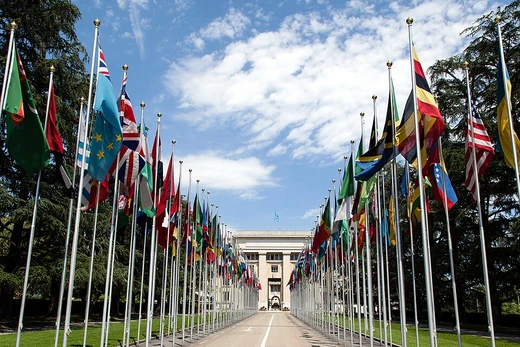
International relations
Academic discipline studying relations among states and international actors.

International relations (IR) is an academic discipline that studies all activities among states—such as war, diplomacy, trade, and foreign policy—as well as relations with and among other international actors like intergovernmental organizations, international nongovernmental organizations, international legal bodies, and multinational corporations. It is generally classified as a major multidiscipline of political science, drawing heavily from fields including anthropology, economics, geography, history, law, philosophy, and sociology. The most prominent schools of thought within IR are realism, liberalism, and constructivism.
- field
- Academic discipline (political science)
- known_for
- Analysis of war, diplomacy, trade, foreign policy, and international actors
- first_offered_as_undergraduate_major
- 1919 at Aberystwyth University, United Kingdom
- major_schools_of_thought
- Realism, liberalism, constructivism
- related_disciplines
- Anthropology, economics, geography, history, law, philosophy, sociology
Lore & Background
International relations emerged as a formal academic discipline in 1919 with the founding of the first IR professorship, the Woodrow Wilson Chair at Aberystwyth, University of Wales (now Aberystwyth University), held by Alfred Eckhard Zimmern. While international politics has been analyzed since antiquity—for example, Thucydides' analysis of the Peloponnesian War and Machiavelli's The Prince—the contemporary field analyzes connections between sovereign nation-states, tracing the modern state system primarily to the Peace of Westphalia of 1648. The Second World War and the Cold War greatly shaped IR scholarship, particularly in North America and Western Europe, and the collapse of the Soviet Union and rise of globalization in the late 20th century presaged new theories.
Reader's Guide
International relations matters because it provides a systematic framework for understanding the political, diplomatic, security, economic, and legal interactions that shape the modern world. As a discipline, it emerged in response to the need to analyze and manage the complex relations among sovereign states and other international actors. Its theories—realism, liberalism, and constructivism—offer competing explanations for state behavior, conflict, cooperation, and the evolution of the international system. The field's multidisciplinary nature, drawing on history, law, economics, and sociology, allows it to address issues from war and peace to trade and human rights. The establishment of IR as an academic discipline in 1919 at Aberystwyth University marked a turning point, institutionalizing the study of international politics. The Cold War and subsequent globalization further expanded its scope, leading to new theories and evaluations of the rapidly changing international system. Today, IR remains essential for policymakers, scholars, and citizens seeking to navigate global challenges.
Did You Know?
- International relations was first offered as an undergraduate major in 1919 by Aberystwyth University in the United Kingdom.
- The most prominent schools of thought within IR are realism, liberalism, and constructivism.
- The Peace of Westphalia of 1648 is considered the starting point of the modern state system in IR history.
More in International Relations And Concepts 1-18
Spotted an error? Know more?
This is a living reference — every entry is fact-audited, and reader corrections feed straight into our audit queue. Suggest an edit · See this site's audit record