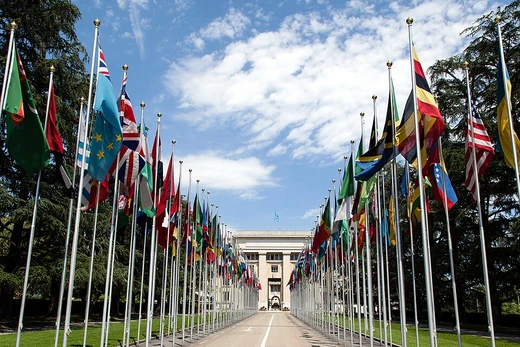
International security
Measures by states and organizations to ensure mutual survival and safety.

International security describes the actions that states and international bodies like the United Nations and European Union take to protect their mutual survival and safety. These actions can involve military force or diplomatic agreements, such as treaties and conventions. National security and international security are closely connected; international security is essentially national security playing out on a global stage. The academic study of this topic, known as security studies, began after World War II. It started as its own field but later became a sub-field of international relations, and since the 1950s it has been a central part of that discipline. The field covers security studies, strategic studies, peace studies, and related areas.
The term "security" is often treated as common sense, understood through an unspoken agreement. Over time, the scope of international security has broadened. Today, it includes many interconnected global issues that affect survival. These range from traditional military power and the causes and consequences of war between states, to economic strength, ethnic, religious, and ideological conflicts, trade disputes, energy supplies, science and technology, food, and threats to human security and state stability from environmental damage, infectious diseases, climate change, and the actions of non-state actors. The broad view considers nearly everything a security matter, while the traditional approach focuses mainly or exclusively on military concerns.
Scholars have described international security in various ways. Edward Kolodziej compared it to a Tower of Babel, and Roland Paris (2004) said it is "in the eye of the beholder." The concept has been used to justify suspending civil liberties, waging war, and massively reallocating resources over the last fifty years. Walter Lippmann (1944) defined security as a country's ability to protect its core values without sacrificing them to avoid war, and to maintain them by winning a war. David Baldwin (1997) argued that pursuing security sometimes requires sacrificing other values, both minor and major. Richard Ullman (1983) suggested security is a decrease in vulnerability. Arnold Wolfers (1952) saw "security" as a normative term, applied by nations as either a rational means to an accepted end or a moral choice. He noted that nations, like people, differ in sensing danger
- field
- International relations, security studies
- key_concepts
- Traditional security, cooperative security, comprehensive security, collective security
- theoretical_approaches
- Realism, neorealism, liberalism, economic liberalism
- notable_theorists
- Walter Lippmann, David Baldwin, Richard Ullman, Arnold Wolfers, Barry Buzan, Edward Kolodziej, Roland Paris
- historical_context
- Emerged as academic field after World War II; peaked during Cold War
Lore & Background
International security as a term encompasses the measures taken by states and international organizations, such as the United Nations and European Union, to ensure mutual survival and safety. These measures include military action and diplomatic agreements like treaties and conventions. The field of security studies emerged as an independent academic subject by the end of World War II, later becoming a sub-field of international relations, and has been at the heart of that discipline since the 1950s. Its content has expanded over the years from traditional military concerns to cover interconnected issues including economic strength, ethnic and religious conflicts, energy supplies, climate change, and threats from non-state actors.
Reader's Guide
The significance of international security lies in its evolution from a narrow, state-centric focus on military power and balance of power during the Cold War to a broader understanding that encompasses human security, environmental degradation, and economic threats. Traditional security, rooted in realist thought and exemplified by writers such as Hobbes, Machiavelli, and Rousseau, viewed the international system as a brutal arena where states seek security at the expense of neighbors. This approach relied on an anarchistic balance of power and absolute state sovereignty. However, as Cold War tensions receded, it became clear that citizens' security was threatened by internal state activities and civil wars, leading to challenges from more holistic approaches like cooperative, comprehensive, and collective security paradigms. Theoretical frameworks such as realism, neorealism, liberalism, and economic liberalism offer competing explanations for how states pursue security, with neorealism focusing on system-level dynamics like bipolarity and multipolarity, and liberalism emphasizing economic openness and interdependence as paths to peace.
Did You Know?
- The meaning of 'security' is often treated as a common sense term understood by 'unacknowledged consensus'.
- Edward Kolodziej compared international security to a Tower of Babel, and Roland Paris viewed it as 'in the eye of the beholder'.
- Arnold Wolfers argued that 'security' is generally a normative term applied by nations to be expedient or moral.
- Barry Buzan viewed the study of international security as not only a study of threats but also which threats can be tolerated.
More in International Relations And Concepts 1-18
Spotted an error? Know more?
This is a living reference — every entry is fact-audited, and reader corrections feed straight into our audit queue. Suggest an edit · See this site's audit record